Choosing the right general contractor can have a major impact on the success of your construction project.
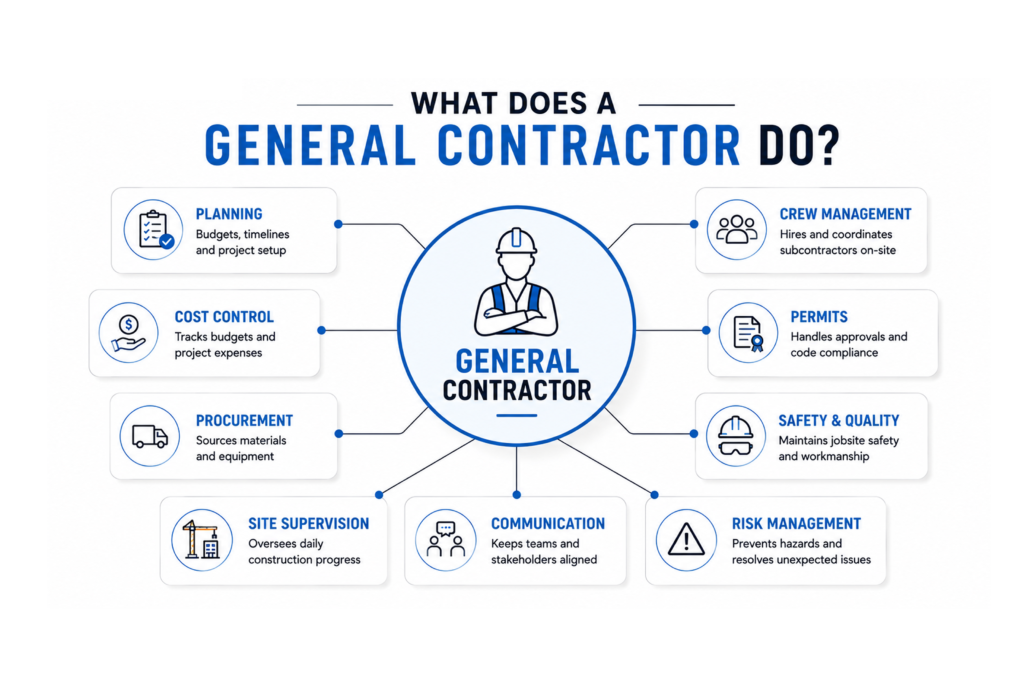
A good contractor helps coordinate the work, manage subcontractors, control the schedule, communicate with the owner, resolve problems, and keep the project moving.
The wrong contractor can create the opposite experience: missed deadlines, unclear costs, communication problems, poor workmanship, and unnecessary stress.
Whether you’re building a new home or undertaking a major renovation, here are 10 things to look for when choosing a general contractor.
1. Relevant Construction Experience
Start with experience—but make sure it’s relevant experience.
A contractor who specializes in small renovations may not be the right choice for a large custom home.
Likewise, a commercial contractor may not be the best fit for a highly detailed residential renovation.
Ask potential contractors:
- What types of projects do you normally build?
- How similar are your recent projects to mine?
- How long have you been operating?
- Who will manage my project?
- Can you show me examples of similar work?
Relevant experience means the contractor understands the specific challenges your project is likely to involve.
2. A Strong Track Record
Look beyond a contractor’s marketing materials.
Ask for references from previous clients and, where appropriate, examples of completed projects.
Useful questions for previous clients include:
- Was communication good?
- Did the contractor meet expectations?
- How were changes handled?
- Were there unexpected costs?
- Was the project completed reasonably close to schedule?
- How did the contractor respond when problems occurred?
No construction project goes perfectly.
What matters is how professionally problems are handled.
3. Proper Licensing and Insurance
Depending on your location and the type of work, contractors may be subject to licensing requirements.
You should also ask about appropriate insurance coverage.
This can include general liability insurance and workers’ compensation coverage where applicable.
Do not be uncomfortable asking for documentation.
A professional contractor should understand why a homeowner wants to verify these details.
4. A Detailed Written Estimate
Be cautious of vague estimates.
A good proposal should make it reasonably clear what is included in the project.
Depending on the job, it may identify:
- Labor
- Materials
- Major equipment
- Allowances
- Subcontracted work
- Exclusions
- Project assumptions
- Payment schedule
A detailed estimate makes it easier to compare contractors.
A very low quote may simply mean that important work has not been included.
5. A Clear Construction Contract
Before work begins, you should understand the contract.
Pay attention to:
- Scope of work
- Price
- Payment terms
- Schedule
- Change orders
- Allowances
- Responsibilities
- Warranty
- Completion terms
If you don’t understand something, ask.
It is much better to resolve uncertainty before construction begins than during a disagreement.
6. Good Communication
Construction involves hundreds of moving parts.
Communication is therefore one of the most important qualities in a contractor.
A good contractor should have a clear process for communicating:
- Schedule updates
- Budget changes
- Material selections
- Site issues
- Inspection results
- Change orders
- Decisions that require homeowner approval
You don’t need to receive a phone call every hour.
You do need to know who to contact and how information will be shared.
7. A Realistic Schedule
Be cautious of contractors who promise an unusually fast completion date without explaining how they plan to achieve it.
Ask for a realistic construction schedule.
The schedule should account for:
- Permits
- Site work
- Material lead times
- Subcontractors
- Inspections
- Weather
- Major milestones
- Finishing work
A professional contractor should be willing to explain the major stages of the project.
8. Strong Subcontractor Relationships
General contractors often coordinate a network of specialized trades.
These may include:
- Electricians
- Plumbers
- HVAC contractors
- Roofers
- Framers
- Drywall contractors
- Painters
- Tile installers
- Finish carpenters
Ask how the contractor selects and manages subcontractors.
Strong relationships can improve coordination and reliability.
9. A Professional Approach to Change Orders
Changes happen in construction.
Sometimes they are caused by the homeowner. Sometimes they’re necessary because of site conditions or other unforeseen circumstances.
The important thing is that changes are documented clearly.
A proper change order should explain:
- What is changing
- Why it is changing
- The additional or reduced cost
- The schedule impact
- Any other relevant consequences
Avoid informal verbal agreements about significant changes.
10. A Contractor You Trust
This final point is easy to underestimate.
You may be working with your general contractor for months or longer.
You need someone who is organized, responsive, honest about problems, and comfortable explaining difficult decisions.
The cheapest contractor isn’t necessarily the best contractor.
The best choice is usually the contractor who provides a reasonable combination of:
experience + communication + workmanship + transparency + value.
Questions to Ask Before Hiring a General Contractor
Before signing a contract, consider asking:
- How many projects like mine have you completed?
- Can I speak with previous clients?
- What licenses and insurance do you carry?
- Who will manage my project?
- Which subcontractors will you use?
- How do you handle change orders?
- What is included in your estimate?
- What is excluded?
- What schedule do you expect?
- How will we communicate during construction?
- What happens if the project encounters unexpected conditions?
- What warranty or post-completion support do you provide?
The answers can tell you a lot about how the contractor operates.
Don’t Choose a Contractor on Price Alone
Price matters.
But construction is not a simple commodity where the lowest number automatically represents the best deal.
A contractor may submit a lower quote by:
- Excluding certain work
- Using different material specifications
- Providing lower allowances
- Underestimating labor
- Omitting site costs
- Assuming a different project scope
When comparing bids, make sure you’re comparing equivalent scopes.
A slightly higher price from a well-organized contractor may ultimately provide better value than a low quote that grows significantly through change orders.
The Bottom Line
Choosing a general contractor is one of the most important decisions you will make during a construction project.
Take time to investigate experience, references, insurance, contracts, pricing, communication, scheduling, and project-management practices.
The right contractor should be willing to answer questions, explain the process, and provide clear documentation.
Most importantly, you should feel confident that the contractor will tell you the truth when something doesn’t go according to plan.
Looking for a construction partner for your next project? Contact our team to discuss your plans and learn how we approach project management, communication, and construction quality.